
By Surabhi Gupta
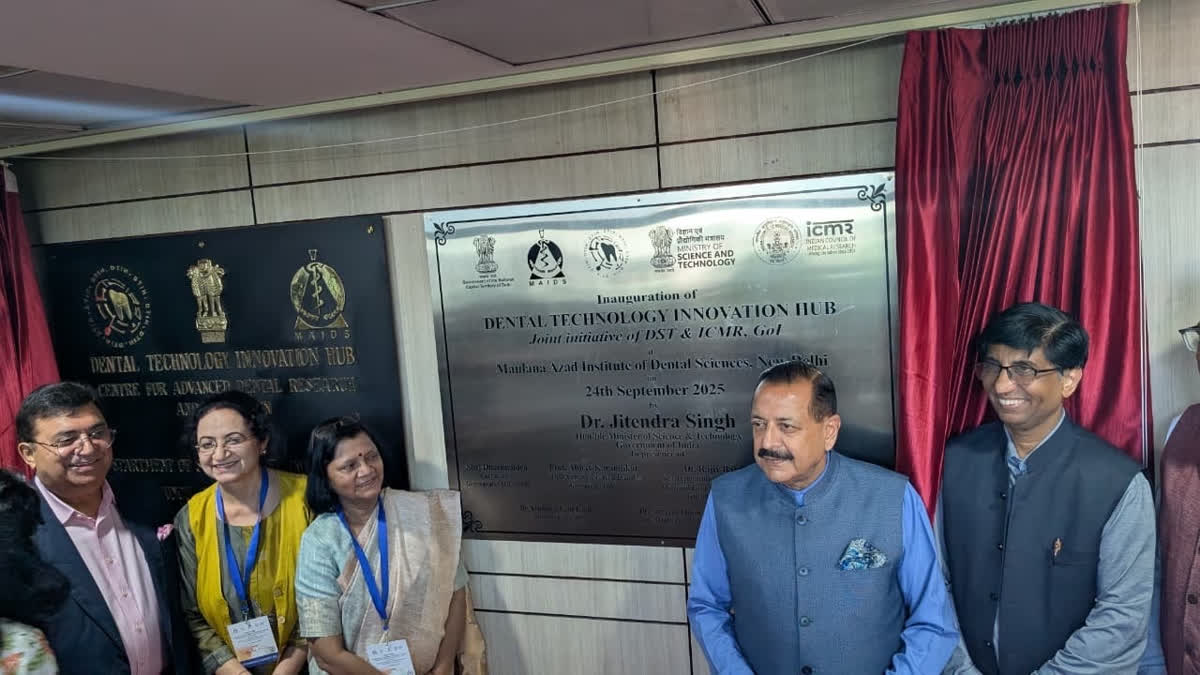
New Delhi: India’s journey towards self-reliance in healthcare technologies received a significant boost with the launch of the Dental Technology Innovation Hub at the Maulana Azad Institute of Dental Sciences (MAIDS) in New Delhi—inaugurated by Union Minister of State (Independent Charge) for Science and Technology, Earth Sciences, and Minister of State in the PMO, Jitendra Singh.
The Hub has received support from the Department of Science and Technology (DST) and the Indian Council of Medical Research (ICMR) under the Tech-ID 2025 program, and hopes to transform the world of dentistry in India through the application of indigenous innovation, high-end quality research, and bridging the gap between doctors and engineers and the dental industry.
“This facility is an important addition to the management armamentarium of the dental profession and aligns with the progressive approach of the Government of India under the leadership of Prime Minister Narendra Modi in every facet of science as well,” explained Jitendra Singh. “This hub will be a cost-effective facility not only for research but also for the costs involved with diagnostics and therapy. It will also contribute to the vision of Atmanirbhar Bharat by diminishing reliance on the import of dental implants and other dental equipment.”
He emphasised that the Hub is designed as an inclusive platform for innovators, start-ups, and MSMEs. “By involving multiple stakeholders, this initiative reflects the concept of whole-of-government and whole-of-nation that the government has been striving for in the last 11 years,” he noted.
Recalling a time when most dental and medical implants were imported, Singh expressed satisfaction that Indian institutions are now producing synthetic and biodegradable materials at par with global standards. “India has progressed from being nearly a decade behind in specialised medical procedures to becoming a world-class hub that also attracts medical tourism,” he said, pointing to reforms like the National Medical Devices Policy 2023 and Medical Devices Rules 2017 that have created an enabling ecosystem.
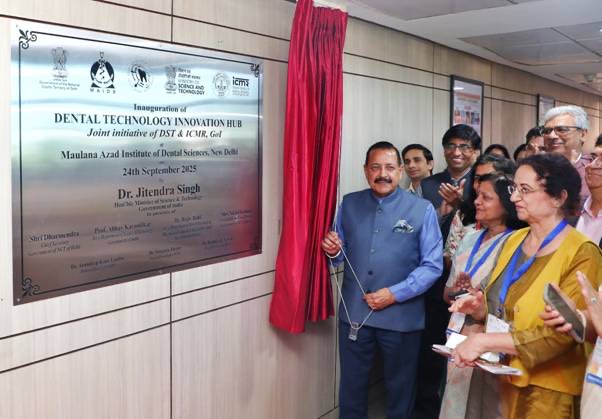
India’s Dental Tech Hub is here (ETV Bharat)
The Minister also underlined the “three A’s” of healthcare: awareness, accessibility, and affordability. He added that while India is making progress on cost and access, much more needs to be done to raise awareness about dental health. “This Hub will prepare the dentists of 2047 for a Viksit Bharat. If we are to ensure sharp teeth for a developed India, it is institutions like this that will provide the backbone,” he further said.
Innovation for every dentist
Among the most celebrated outcomes of this initiative is the development of indigenous dental devices that promise to revolutionise common procedures such as root canal treatments.
Talking to ETV Bharat, Vivek Hegde, Vice Principal of Rangoonwala Dental College & Research Centre, Pune, explained its significance. “This program, Tech-ID 2025, is organised by the Department of Science and Technology. The Dental Technology Innovation Hub at Maulana Azad Institute has taken this initiative over the past few years. We applied for a project under this program, and we were fortunate to be selected,” he said.
He said that the project was innovative and addressed a genuine need in dentistry. He added that every dentist required the device because it was not only indigenous but also user-friendly, reliable, and economical—qualities that were especially important given India’s large population and diverse economic conditions.
“Millions of root canal treatments are performed every year. Traditionally, dentists used spirit lamps and crude instruments to cut and seal gutta-percha filling material. To solve this problem, we developed a device called Down Pack. It is a heated probe that reaches 180°C to 250°C in just 2–5 seconds and cools quickly, allowing for a precise and clean job with no heat loss and no damage to the tooth structure,” he further said.
“Such a device had to be imported earlier at a much higher cost. By making it here under the Make in India initiative, we are reducing costs and ensuring wider accessibility. Our mission is clear: every dental clinic in India, regardless of size, should be able to afford and use such high-quality devices,” Hegde added.
Engineering meets dentistry
Kalyan Sundaram, a former scientist and now associated with the Dental College in Pune, believes this is just the beginning of a new era.
“My aim is to introduce Dental Engineering in India,” he told ETV Bharat. “Until recently, doctors worked separately, engineers worked separately, and innovators and investors were not aligned. But now, we are building a culture where everyone, doctors, engineers, marketing experts, innovators, and investors, works together as one family.
“At present, about 85 per cent of medical and dental products are imported. This dependency has to change. If we develop indigenous products, dentists will have reliable tools, and India can move towards becoming the medical capital of the world. After all, without the right products, what I call the ‘weapons of dentistry,’ a dentist cannot work effectively, and those products are designed and built by engineers,” he added.
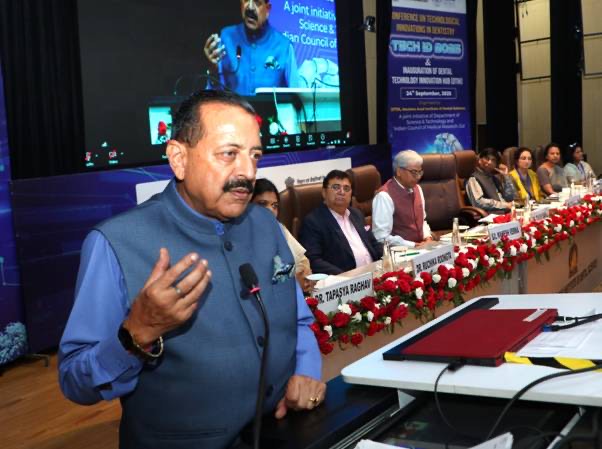
Union Minister of State for Science and Technology, Jitendra Singh (ETV Bharat)
Sundaram said that innovation was in India’s blood and was often referred to as “jugaad,” though it was now evolving beyond mere quick fixes. He explained that with advancements in technology and mobile platforms, collaborations were occurring much faster. He noted that solutions were frequently found within existing networks, which helped reduce both cost and dependency.
He emphasised that the focus should not be restricted to dentistry alone but should also extend to biomedical production for healthcare, agriculture, and medicines. “If we invest in innovation and indigenous production in these areas, we can truly move towards a Viksit Bharat,” Sundaram said.
Advanced research tools: Chewing simulator
One of the highlights of the MAIDS Hub is its chewing simulator, an advanced machine designed to replicate natural chewing conditions. Asif, a researcher at MAIDS said, “This machine is designed to test how much strength a tooth can bear. The liquid inside works like saliva, allowing us to mimic natural chewing cycles and record the force applied until the tooth fails.”
“The data we generate is extremely useful for crown-making procedures, helping us determine the ideal thickness of crowns, night guards, and prosthetics to ensure durability. At present, there are only two such machines in India, one at MAIDS and another at Vishnu Dental College in South India,” he added. “Under the guidance of Ruchika Naval and Sangeeta Talwar, we have been able to bring such advanced testing facilities to India and improve patient care.”
Cutting-edge devices from IIT Delhi
Adding to the excitement, Shahid Malik, professor at IIT Delhi, presented five innovative devices developed by his team. “Our first product is a tooth shade detection device, a handheld tool that captures an image of the patient’s tooth and instantly provides the exact replacement shade,” he said. “The second is an extended ultrasonic scaler that allows safe removal of broken endodontic files inside the tooth with minimal damage.”
Malik said that they are also developing an intraoral AI-powered camera system to enable early detection of dental problems, along with a tooth ultrasound scanner capable of checking blood flow inside the tooth—an innovative technology not yet available globally.
“All these projects share the same goal: to be innovative, cost-effective, and user-friendly, so that every dentist and every clinic in India can have access to advanced technology,” he added.
Indigenous manufacturing gains momentum
Industry players are equally enthusiastic. A representative from Digident India described their work, “We have been running our lab for 11 years and identified problems faced by labs across India. Our TruAlign and TruLine concepts ensure that dental models are perfectly aligned, improving treatment accuracy.”
“Our titanium scan body achieves 10-micron accuracy, and our PVD-coated screws prevent loosening while remaining removable. With 99 per cent of our products made in India, and only titanium imported for now, we are fully committed to Make in India,” they said.
Similarly, Raghav Verma, manager at Dental Avenue, emphasised, “We have an ISO-certified facility in Bhiwadi where we manufacture impression materials, root canal servers, and endodontic files. By controlling manufacturing and quality, we reduce costs without compromising international standards.”
Beyond dentistry: Healthcare innovation at large
The event also spotlighted innovations beyond dentistry. Professor Sasikala from Anna University told ETV Bharat, “Since 2011, we have been developing indigenous medical devices. Our latest is an antibiotic susceptibility testing device that delivers results in six hours instead of 48, helping doctors start the right treatment faster. We have calibrated over 20,000 medical devices in 400+ hospitals. The technology has been transferred to an industry partner in Coimbatore and is already deployed across South India.”
Yogbharti, a researcher at NHHID, added, “Our device uses a 96-well plate preloaded with antibiotics and AI-based software to generate detailed reports, reducing misuse of antibiotics and supporting better patient outcomes.”
Vikas, from the partner microbiology lab, called the machine “cost-effective and life-saving,” noting that it has already run over one lakh human samples and has received “highly positive feedback from doctors and patients.”
A Vision for 2047
Experts agree that such initiatives are vital as India prepares for its demographic and health challenges. Jitendra Singh reminded the audience that the demand for dental and medical care is growing with increasing life expectancy, and that dental science is now closely linked with endocrinology, cardiovascular medicine, and diabetes management.
He urged greater use of AI and stronger partnerships with engineering institutions to create a robust innovation ecosystem. “Integration between public and private sector stakeholders is essential,” he said, while announcing that the government will add 1,000 new undergraduate medical seats and 5,000 postgraduate seats, including dental sciences.
Notably, on Tuesday, September 23, Delhi’s Health & Family Welfare Minister Pankaj Kumar Singh inaugurated the Delhi Dental Council (DDC) and the Central Tissue Bank at the Maulana Azad Institute of Dental Sciences (MAIDS).
The upgraded DDC office marks a major step forward in digitisation, offering completely online facilities for dentist registration, renewals, and related services. The new cashless “V-Office” system makes DDC the first state dental council in India to provide such a service for the dental community.
Speaking ahead of the inauguration, DDC Registrar Gyanendra Kumar said the dual initiative reflects Delhi’s commitment to modernising dental governance and improving clinical support for patients.
A key highlight of the inauguration is the establishment of the Central Tissue Bank in the Department of Periodontology. This state-of-the-art facility will enable patients requiring tissue or bone grafts to access them directly at MAIDS, eliminating the need to purchase such materials from private markets. It is the first dedicated tissue bank in any dental institution in India, setting a new benchmark for accessibility and patient care.
link