
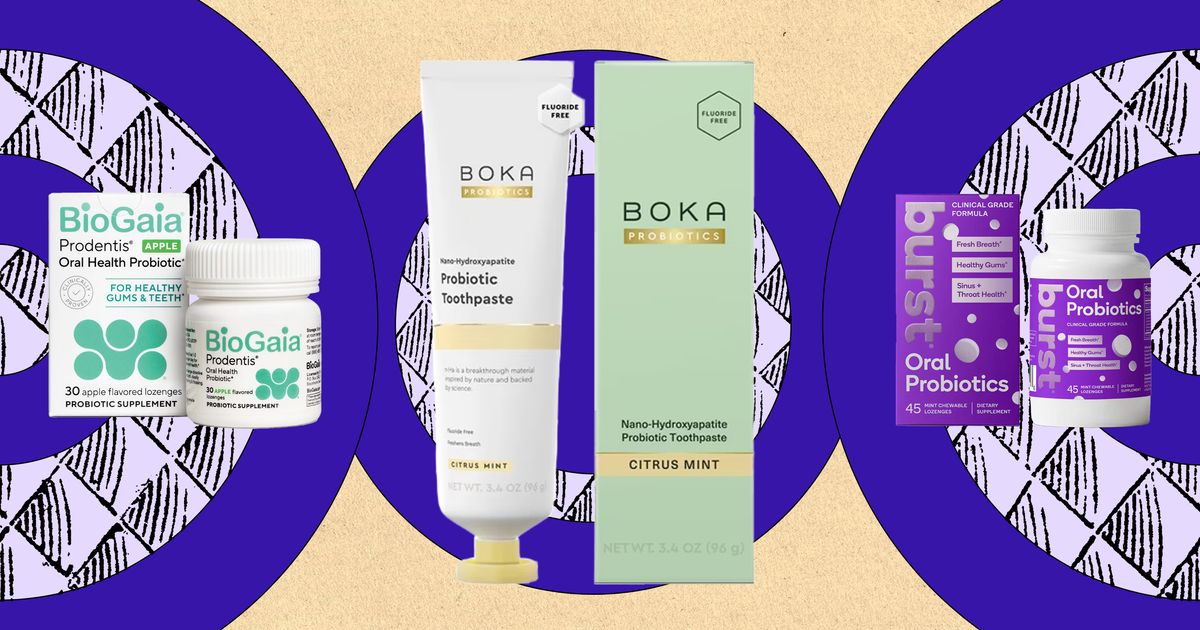

Photo-Illustration: The Strategist; Photos: Retailers
As someone who writes about the best toothpastes, toothbrushes, and water flossers, I get a lot of content about the newest gadgets and supplements in the dental space. In the last six months or so, one thing I’ve been noticing — both on dental-routine TikToks and in email pitches — is dental probiotics. I’ve seen claims about them balancing the oral microbiome and how necessary they are for good oral health, so I decided to look into it. To get a sense of how effective they are and what to look out for, I spoke to two experts: general dentist Dr. Anjali Rajpal and functional dentist Dr. Victoria Sampson, who’s known for her work in developing salivary diagnostics and microbiome testing.
Before diving into the answer, it’s worth noting that the oral microbiome is the second-largest and most diverse microbiome after the gut. It contains over 700 different types of bacteria, both good and bad, which should be balanced for a healthy oral microbiome. Dental probiotics contain different strains of bacteria in the form of lozenges, chewables, toothpastes, and mouthwashes. They work to balance the oral microbiome by introducing good bacteria. “I like to think of the oral microbiome as a big party with hundreds of people. You’re trying to put more good people in there. The ‘good guys’ competitively push out the ‘bad guys,’ since there’s only space for a certain amount of bacteria in that microbiome,” says Dr. Sampson. She explained that the good bacteria recolonize your mouth by releasing certain enzymes that kill bad bacteria. This allows the good bacteria to survive better and modulate things like inflammation.
Some common causes of having too much bad bacteria in the oral microbiome are poor oral hygiene (not flossing and brushing twice a day), having a sugar-heavy diet, smoking, certain medical conditions (like diabetes and autoimmune diseases), and taking certain medications. An imbalanced oral microbiome has both local and systemic impacts, according to Dr. Sampson. The local effects — things that happen in the mouth — are things like bad breath, gum disease, high levels of cavities, funny tastes, and ulcers. The systemic effects are inflammation that can travel throughout the rest of the body, contributing to things like rheumatoid arthritis, heart disease, high blood pressure, diabetes, and infertility, says Dr. Sampson.
Dr. Sampson says that a balanced oral microbiome via taking a dental probiotic can help with these local and systemic issues. When I looked into clinical studies that could back this up, though, the results mainly showed improved conditions in the mouth. One study showed that a dental probiotic can reduce enamel demineralization by balancing the saliva pH. Another showed that taking a dental probiotic reduced a bacteria known to cause cavities and was effective at reducing plaque and improving gum health. It’s also worth noting that these studies were done within short time frames (4 to 12 months). More research is needed to back up claims that there are marginal systemic benefits.
When shopping for a dental probiotic, the strain of bacteria is one of the most important things to consider. Dr. Rajpal and Dr. Sampson both called out Streptococcus salivarius (or S. salivarius) K12 and M18 for gum health and halitosis (bad breath), Lactobacillus reuteri (or L. reuteri DSM 17938) for gum health, and Lacticaseibacillus paracasei (formerly known as Lactobacillus paracasei) for gum health and strengthening enamel. Dr. Sampson says there are more out there, but these are the ones with the most research behind them.
It’s also important to consider how the probiotic is taken. Experts told me a lozenge or chewable tablet is the most common and effective method, since the probiotic bacteria can stay in contact with the oral tissues, which is needed for it to work. If you don’t want to add an extra step into your routine, a toothpaste works well, too. Dr. Sampson says what’s important is that the probiotic is “woken up” from either chewing or brushing. “The reason for that is that these live strains are ‘put to sleep’ in order for them to have a longer shelf life, and you need to activate them somehow,” she says.
You may start to notice fresher breath after a week or so, says Dr. Sampson, but it’s important to stay consistent for at least three months for benefits like reduced plaque and gum health. This could also vary depending on the state of your mouth before taking the probiotics. Dr. Sampson emphasizes that while probiotics are effective, they’re “not the golden elixir to cure everything. They’re an adjunct that’s going to help you with whatever you’re fighting.” Also worth noting: Once you stop taking dental probiotics, the oral microbiome usually gradually returns to its previous state.
It might go without saying, but if you’re not flossing and brushing twice a day and getting regular cleanings done, the effectiveness of dental probiotics goes down significantly. On top of that, both Dr. Rajpal and Dr. Sampson say that products with added sugars, artificial dyes, and unnecessary fillers can undermine oral health. That includes alcohol (found in some mouthwashes), sodium lauryl sulfate, foaming agents, and parabens, says Dr. Sampson. “[These ingredients] can mean that the probiotic is not going to be absorbed as well. It can also mean that the environment for that probiotic to survive is being damaged and impacted,” she says.
See All
The Strategist is designed to surface useful, expert recommendations for things to buy across the vast e-commerce landscape. Every product is independently selected by our team of editors, whom you can read about here. We update links when possible, but note that deals can expire and all prices are subject to change.
link