
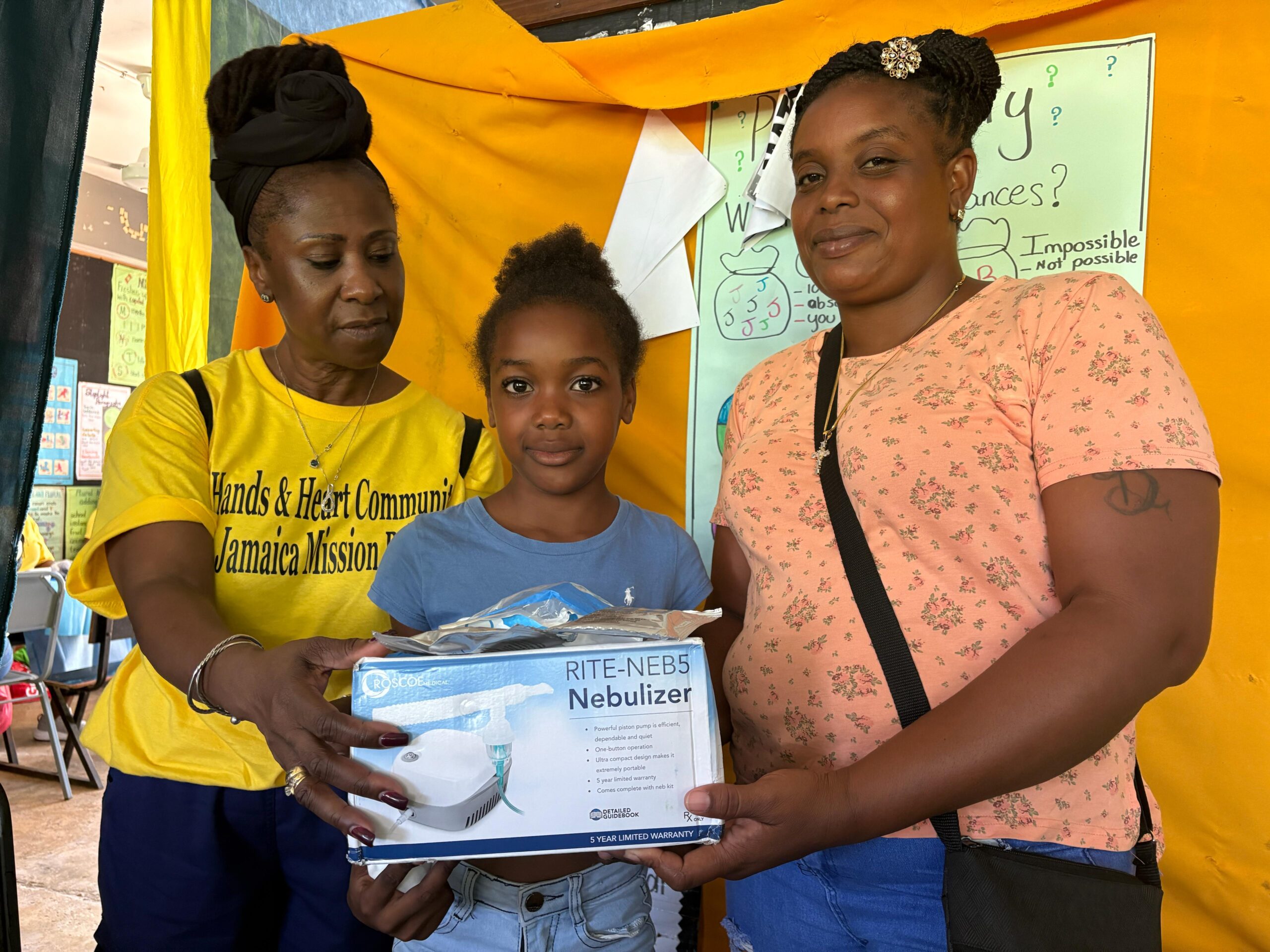
From December 17–20, 2025, a powerful act of compassion swept through the farming community centered at Little London Primary School in Westmoreland, Jamaica.
For three days, as hundreds in the rural village prepared to celebrate Christmas 2025, medical and dental volunteers transformed the school grounds into a hub of healing and hope for a community still traumatized by the devastation of Hurricane Melissa, which made landfall in Jamaica on October 28.
Though Dr. Dwight Williams, a U.S. board-certified oral and maxillofacial surgeon and founder of Jamaica-based Emirates Facial & Dental Implant Center (EFDIC), was thousands of miles away attending to business in New York, Morvia Reid-Williams, a trained social worker and EFDIC’s chief financial officer, led the successful mission to Little London.
“This mission was intentional,” Reid-Williams told Caribbean National Weekly. “The purpose was to touch and change the lives of everyone we came in contact with. They should not leave the same way they came through the gates of Little London Primary School. The people we served needed to know that we saw them, we heard them, and that we care,” she said.
Supported by a coalition of U.S.-based and Jamaican nonprofit organizations and medical professionals, Reid-Williams and her team of volunteers delivered a wide range of dental and medical services, including dental extractions and emergency care, blood pressure and diabetes screenings, wound care, mental-health first aid, one-on-one psychological counseling, child art therapy, and patient education on chronic illnesses such as hypertension and diabetes. Meals and care packages were also distributed daily, offering both nourishment and dignity.
Dr. Natalie Irving-Mattocks, co-founder and executive director of C-TECH (Caribbean Technical Assistance and Education Centre for Health), said what her team of six medical doctors and four psychologists encountered went far beyond physical illness.
“Our team observed significant psychological distress among affected community members, including widespread depression and multiple cases of suicidal ideation,” Irving-Mattocks said. “Many individuals reported having lost everything and expressed profound hopelessness, stating that they could see no path forward and, in some cases, no reason to continue living. These findings indicate a serious and escalating mental-health crisis.”
She warned that without sustained psychosocial support, the long-term impact could include worsening depression, increased suicide risk, and diminished capacity for individuals and families to recover and rebuild their lives.
For Reid-Williams, the emotional toll on children was especially troubling.
“When you’re a child, what happens to you sticks with you,” she said. “They have to have a place to compartmentalize this trauma and learn ways to deal with it.”
More than 50 children between the ages of three and 12 participated in art therapy sessions, expressing fear, sadness, and hope through drawings. Each child received toys and clothing—small gifts that brought moments of joy amid uncertainty.
“Sometimes, out of bad things come good things,” Reid-Williams reflected. “There was a lot of trauma bonding—people coming together because of similar circumstances. They’re all in survival mode.”
Dental care emerged as one of the most urgent needs.


“More than 80 percent of the patients we saw had dental emergencies,” Reid-Williams said. “There were children as young as five who had gone weeks with sleepless nights due to severe toothaches. Adults had broken-down, decayed teeth, causing severe swelling and infections that distorted their faces.”
While the dental team worked tirelessly, the overwhelming demand meant not everyone could be treated.
“That was heartbreaking for us,” she admitted. “But we did the best we could in the short time we had.”
‘They came with love’
The significance of the mission was underscored by Rev. Hartley Perrin, Custos of Westmoreland, who addressed the community to kick-start the dental and medical outreach.
“Those of us who live here know the trauma that we have been through,” Perrin said. “Melissa passed through with fury and fire and created much dislocation and discomfort. What we need more than ever are people who come with love and care, realizing how much hurt we’ve been through—and they’ve come with love.”
He praised the breadth of services provided. “The facilities are medical, dental, and psychological. It’s a wide gamut of service,” he said, reminding residents to show appreciation. “We did not ask them to come. They volunteered to come because they love us.”
Even amid scarcity, Perrin emphasized resilience. “We don’t have much,” he said, “but we have life. And where there is life, there is hope.”
For many volunteers, the experience was life-changing. Dr. Alexia, one of the medical professionals who joined the mission, described the impact in deeply personal terms.

“I’ve not fully absorbed the experience,” she said. “But I keep thinking about how amazing this team is—not only the force of nature organizing everything, but every single person’s individual contribution.”
She spoke of being welcomed “with open arms” by Reid-Williams and the rest of the volunteers, and of her love for Jamaica’s culture of “One Love and kindness.”
“In three days, we impacted countless lives,” she said. “I am eternally thankful for the collaborative effort to take care of the Little London community, and I hope to work with this team again.”
With support from organizations including United Mission of Goodwill, Caribbean Girls Mission of Hope, Giving JA, Hands and Heart Jamaica Mission Relief, and others, more than 1,000 care packages were distributed. The Savanna-la-Mar Hospital maternity and pediatric wards also received supplies, medication, and newborn baskets.

“Needless to say, our donations did not fill all the gaps,” Reid-Williams acknowledged, “but they were helpful and went a long way.”
As the mission concluded, the message was clear: while the challenges facing Little London remain immense, the presence of caring hands and listening ears offered something priceless—reassurance that the community has not been forgotten.
Irving-Mattocks reiterated that beyond the immediate support provided by the Emirates Facial & Dental Implant Center, C-TECH, and other partners, sustained care is essential to the healing process. She stressed the need for expanded community-based counseling, trauma-informed care, referral pathways linking health facilities and social services, and training for frontline workers to identify and respond to mental-health and gender-based violence risks.
Reid-Williams concluded, “On behalf of Emirates Facial & Dental Implant Center and our collaborating sponsors, we thank the people of Little London for allowing us to serve them, with the intention of helping to rebuild their lives by healing from the inside out. One Love. One Heart. One Jamaica.”
link